




Blog Construction change management
8 Changes That Should Trigger a Construction Change Management Review
Justrite Safety Team Safety Content · Published
Shop the catalogue
Cabinets, cans and containment, in stock
Spill containment, safety cabinets and eyewash equipment for active job sites.
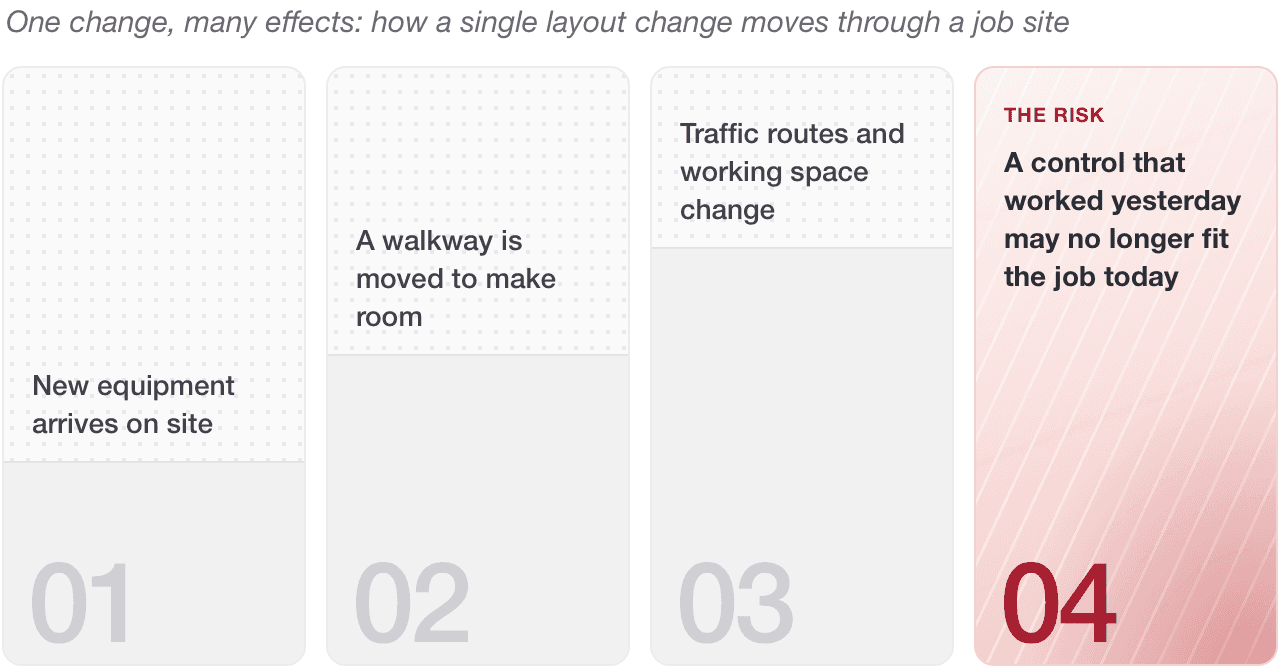
Start shoppingA new piece of equipment arrives, so the team moves a walkway to make room. Work continues, but the change affects more than where people walk. Traffic routes may look different, workers may have less space, and a safety control that worked yesterday may no longer fit the job today.
That's the kind of change construction change management is meant to catch. If no one takes another look, the site plan can fall behind the work happening in the field.
Change management in construction is the process of identifying, reviewing, and managing changes that affect a project. Teams often focus on cost, scope, and schedule. Safety needs a place in that review too. New crews, materials, equipment, work methods, or site layouts can introduce hazards or affect controls already in place.
In this blog, you’ll see eight construction changes that should prompt a safety review and a simple process your team can use to check that controls still work as the job moves forward.
What Is Change Management in Construction?
Change management in construction is a structured approach to identifying planned or unexpected changes, understanding their effects, approving the response, and communicating it to the people involved.
Construction change management often focuses on scope, cost, schedule, resources, contracts, and approvals. Those issues need attention, but a project change can also affect the hazards workers face or the controls already in place.
A revised delivery schedule could bring trucks through an area when more workers are present, a replacement product could carry different storage or exposure risks, or a new work method could put trades closer together than planned.
A strong process gives safety a clear place in the decision. Your team looks at what’s changing, which controls may be affected, and what needs to be checked before the changed work begins. Minor updates may need a quick check, while larger changes may call for a deeper review.
Why Safety Belongs in Construction Change Management
A project change can affect safety even when it wasn’t the reason for the change. If a construction change management process focuses only on cost and schedule, a new hazard could reach the field without proper review.
Look at how the change affects the work people will perform. It could introduce a hazard, increase an exposure, or weaken a control that worked under the old conditions. The review should fit the possible effect of the change.
OSHA 1926.20 requires that job sites, materials, and equipment be inspected regularly and frequently by competent people chosen by the employer. OSHA violations on construction job sites state that conditions still need to be checked in the field as the work develops.
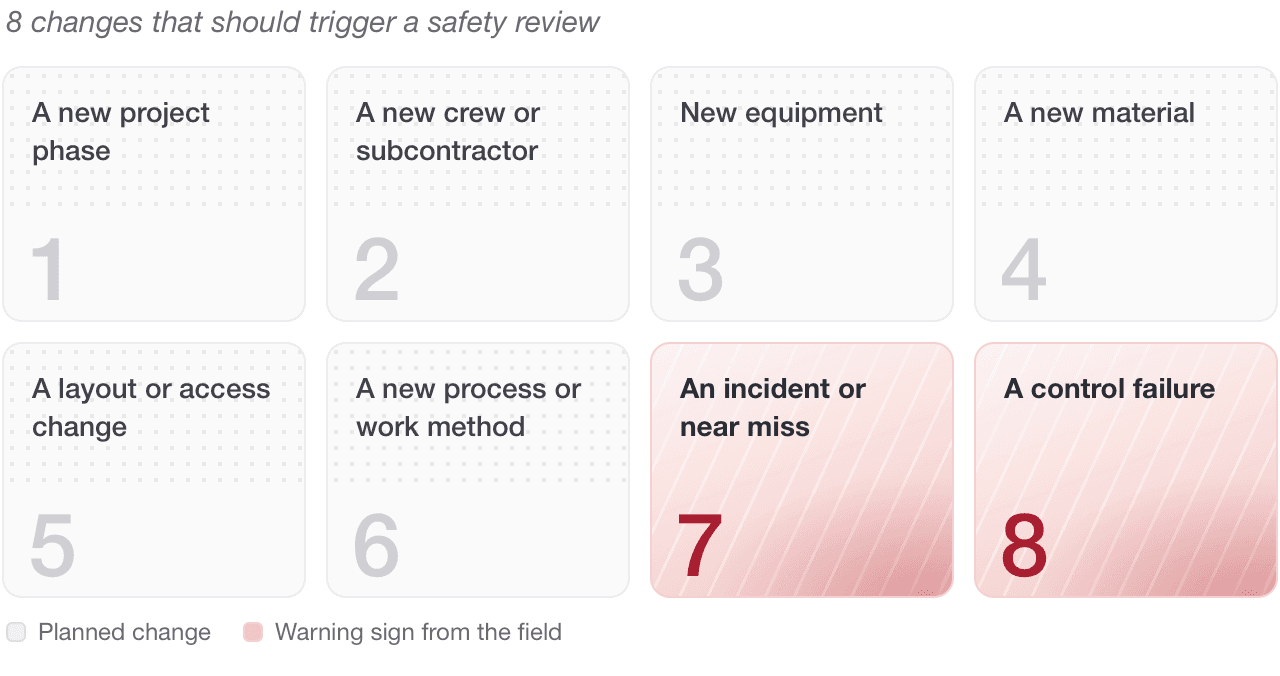
Which 8 Changes Should Trigger a Safety Review?
This change trigger list supports construction change management by identifying eight situations that can signal it's time to check the safety controls already in place.
1. A New Project Phase
A new phase can change the type, location, or sequence of work. Structural work may involve adding lifting zones or working at height. Interior work may bring more trades into tighter spaces with different access needs.
Before the phase begins, walk through the planned work and the hazards tied to it. CPWR defines pre-task planning as a process completed before a task starts to discuss the work steps, hazards, and available controls. That conversation can help crews spot gaps before the next phase begins.
2. A New Crew or Subcontractor
When a crew changes, workers may bring different tasks, equipment, experience, and communication needs. Their work may also affect people employed by another company.
Check that the incoming team understands the site rules, the controls already in place, and what’s expected if conditions change. OSHA’s communication and coordination guidance says that employers and contractors should consider how their work and safety activities can affect others on site.
3. New Equipment
New equipment can impact other things in its environment. A crane may affect overhead work and exclusion zones. A telehandler may change traffic routes, visibility, ground conditions, or pedestrian access.
Confirm who can operate the equipment and what training, inspections, clearances, or barriers apply. Then look beyond the machine itself. Consider how its arrival affects nearby work and movement through the site.
4. A New Material
A new material or replacement product may bring different storage, exposure, fire, spill, or disposal needs. A setup that worked for a small quantity may not fit a larger delivery.
Review the material information before it reaches the work area. Check its storage, compatibility, worker instructions, and emergency needs. For projects that manage fuels or oils, Justrite’s guidance on SPCC and SWPPP requirements provides additional context for spill and containment planning.
If you oversee several projects, one of these changes can easily look routine. Justrite’s Multi-Site Construction Safety Standardization Toolkit includes a Change Trigger Checklist that gives teams a shared way to decide when another safety review is needed.
5. A Layout or Access Change
Moving a fence, storage area, delivery point, or temporary walkway can change how people and vehicles move through the site. It can also affect access to exits, fire extinguishers, eyewash stations, or emergency routes.
Walk the new route instead of relying on the revised drawing alone. Check sightlines, crossings, barriers, signs, and access to emergency equipment. Justrite’s guide to weekly inspections for emergency eyewash equipment shows how access, lighting, and markings can affect emergency readiness.
6. A New Process or Work Method
A different way of completing a task may change the work steps, tools, worker position, or nearby exposures. Replacing one cutting method with another, for example, could affect dust controls, guarding, noise, or protective equipment.
Break the new method down before crews rely on it. Ask the workers who’ll perform the task what has changed and which controls may need another look. CPWR’s pre-task planning approach can help keep that review tied to the work crews are about to perform.
7. An Incident or Near Miss
An incident or near miss gives you new information about the job. It may show that a control was missing, hard to use, misunderstood, or unable to manage the hazard under real conditions.
Go back to the affected task and look for the same setup elsewhere on site. If several projects use the same control, share the finding so other teams can review it before the problem happens again.
8. A Control Failure
A control can fail when it’s missing, damaged, blocked, unsuitable, or not being used as planned. Address the immediate problem, then look at how the gap developed and whether it could exist elsewhere.
What to Do When Safety Is Affected
Once a construction change review points to a possible safety effect, your team needs a short process that leads to a clear decision. Justrite’s toolkit uses five steps.
| Step | What Your Team Does | ||
| Pause | Hold the affected work when needed, so the change doesn’t move forward without a safety check | ||
| Review | Identify what changed, which hazards are involved, and which controls may be affected | ||
| Update | Revise the plan, control, assignment, or site setup based on the review | ||
| Communicate | Tell affected crews and contractors what changed and what they need to do | ||
| Verify | Check in the field that the updated control is present, understood, and working | ||
The pause should fit the risk. It may mean holding one activity rather than stopping the entire project. Bring the people closest to the work into the review. OSHA’s worker participation guidance notes that workers can provide useful information about hazards and program gaps.
Record the decision, owner, required action, and proof of completion. A short record can help the next supervisor or crew understand what changed and what needs to stay in place.
Specification help
Have someone check your storage layout
Send a site photo and a quantity list. No charge, no obligation.
How to Keep Construction Change Management Consistent Across Job Sites
A construction change management process can use the same review triggers across the company without forcing every site to respond in the same way. A new material should raise the same safety question at each applicable job site, but the answer will depend on the material, quantity, work area, and people exposed.
Set clear expectations for who leads the review, how teams receive updates, what gets recorded, and how completion is checked. This gives leaders a clearer view across projects while leaving room for site teams to choose controls that fit local conditions.
Consistency can also reveal repeat problems. If layout changes keep blocking emergency access at several sites, the company may need to strengthen its baseline for routes and equipment placement.
What Happens When Changes Go Unchecked
An unchecked change can leave safety controls tied to an earlier version of the job. A traffic plan may show a route that no longer exists, spill equipment may no longer match the material in use, or a crew may start work without knowing about a hazard created by another trade.
The result can be a hazard with no clear owner. The same issue can also appear across projects if teams keep working from an outdated assumption.
Not every change creates a new safety problem, but a review tells you which ones do. That check may confirm the current controls still work, or it may show that something needs to change before work continues.
Keep Safety Moving With the Job
Construction projects evolve as work progresses, and construction change management gives your team a way to keep safety in step with them. You've seen eight changes that can signal it's time to review your safety controls, including new crews, equipment, materials, incidents, and control failures.
Going forward, give teams a clear way to recognize these changes before they become part of the normal routine. A short safety review can help confirm that the controls in place still match the work crews are doing today.
If you’re working to standardize those reviews across job sites, Justrite’s Multi-Site Construction Safety Standardization Toolkit includes a Change Trigger Checklist your teams can use to flag when a safety review is needed.
Free site assessment
Walk your job site with a Justrite specialist
Get a second set of eyes on storage, spill control and emergency equipment before the next phase starts.
Toolkit
Multi-Site Construction Safety Standardization Toolkit
Includes a Change Trigger Checklist your teams can use to flag when a safety review is needed.
Get the toolkitFAQs
Does OSHA Require Construction Change Management?
OSHA doesn’t have one general construction requirement under that exact name. Employers still need to follow the safety standards that apply to their work and address applicable hazards. Some operations involving highly hazardous chemicals may fall under OSHA rules with specific management-of-change requirements.
How Does Change Management Differ From a Change Order?
A change order records an approved adjustment to a project’s scope, cost, schedule, or other contract terms. Construction change management covers the broader process of reviewing the effects of a change, deciding how to respond, and communicating that decision to the people involved.
How Should Temporary Construction Changes Be Handled?
Treat a temporary change as something that still needs an owner and an end date. Record why it’s needed, how long it can remain, and what needs to happen before the original setup returns. This keeps a short-term workaround from becoming part of the job without another review.
How Can Workers Report an Unplanned Change?
Give crews a clear reporting route, such as a supervisor, safety lead, phone number, or mobile form. Workers should know who to contact, what information to share, and what happens after they report a concern. OSHA recommends responding to safety concerns and protecting workers from retaliation.
What Happens When a Proposed Change Is Rejected?
Record why the change was rejected and tell the affected crews before work continues. Keep the approved plan and controls in place unless another approved option replaces them. Clear communication can reduce the chance that someone acts on an outdated proposal.
Find a Justrite distributor
near your site
Local distributors stock cabinets, cans
and containment for fast delivery.